Autonomous racing · 2020–2021
Indy Autonomous Challenge
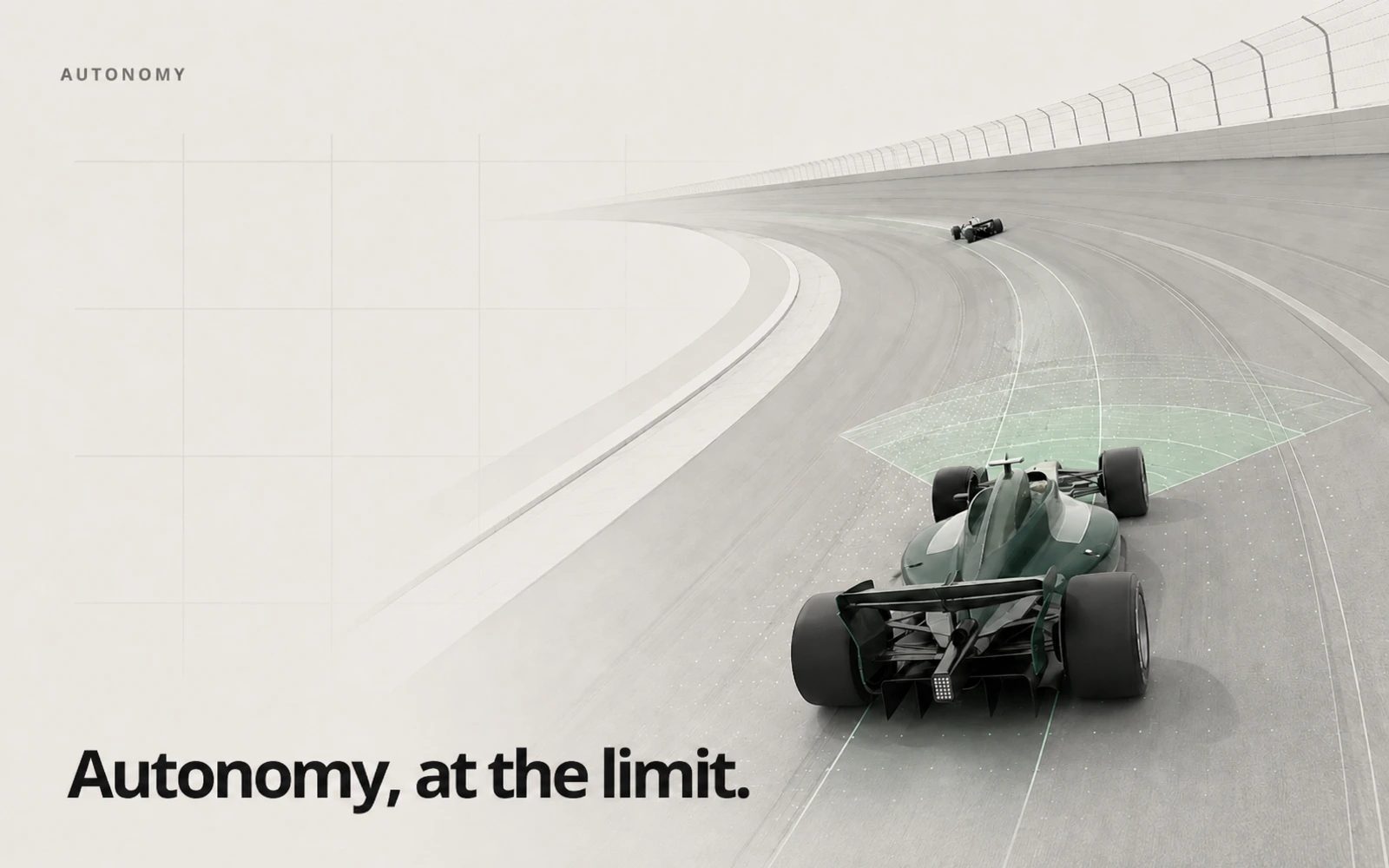
Safety supervision and mission management for an autonomous race car operating above 270 km/h.
01
Overview
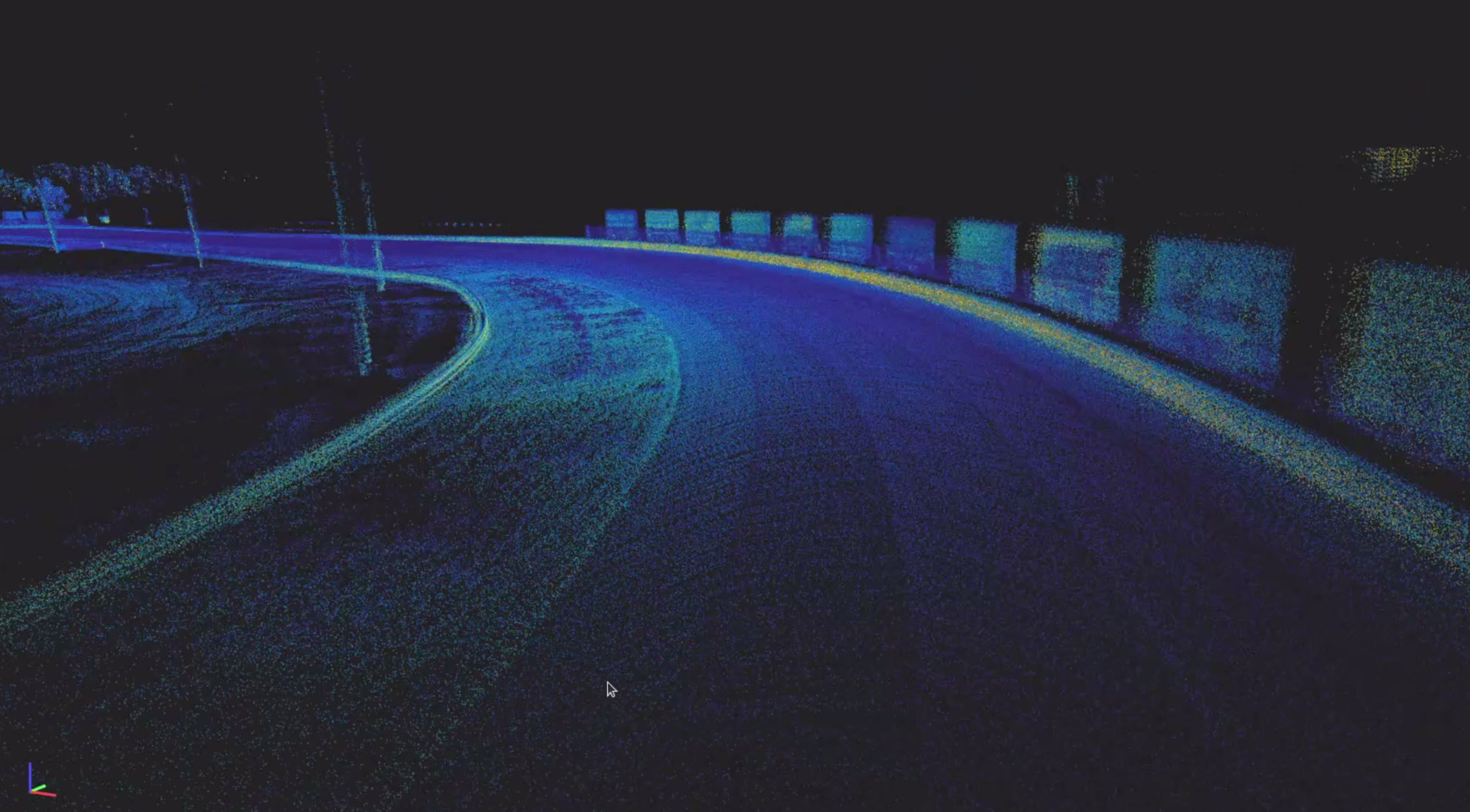
I worked with the TII EuroRacing team on the Indy Autonomous Challenge between May 2020 and November 2021. The team developed er.autopilot 1.0, a complete autonomy stack for the Dallara AV-21: a 390-horsepower, drive-by-wire race car equipped with GNSS, LiDAR, cameras, and radar. The system avoided static obstacles, performed active overtakes, and ran above 75 m/s (270 km/h); the team finished second and third in the competition’s first two main events.
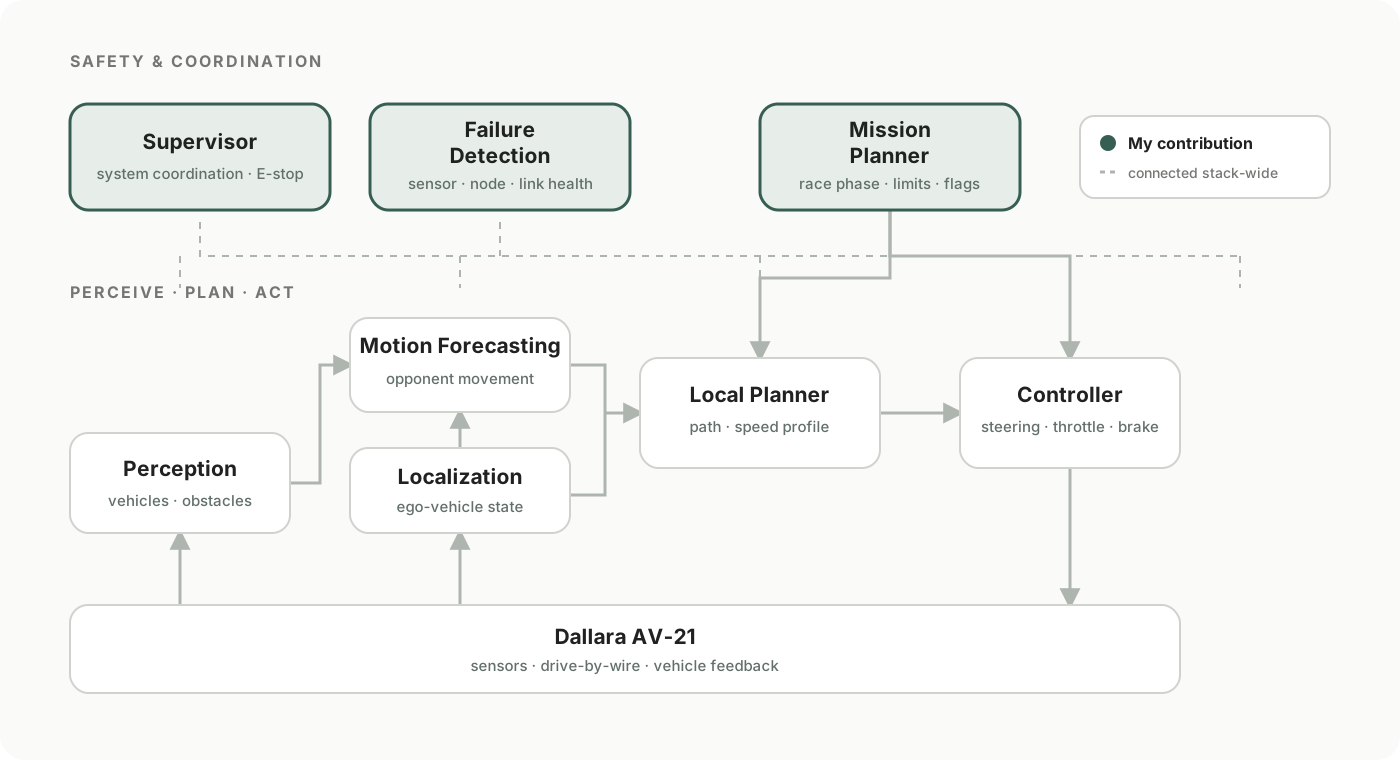
The software was organized as ROS 2 nodes communicating through Eclipse Cyclone DDS. Perception, localization, motion forecasting, local planning, and control formed the driving pipeline, while supervision and failure detection provided a separate, redundant safety layer. I was responsible for the central Supervisor and Failure Detection module and contributed to the Mission Planner—the components that decided what the car was allowed to do and whether it was safe to continue.
I later co-authored the paper er.autopilot 1.0: The Full Autonomous Stack for Oval Racing at High Speeds, which documents the architecture, its track performance, and the lessons learned from racing at the Indianapolis and Las Vegas Motor Speedways.
02
My contribution
- Developed the central Supervisor that coordinated start-up and emergency-stop decisions from system faults, Race Control, the Mission Planner, and the pit-crew joystick.
- Built the Failure Detection module to validate sensor ranges, monitor critical powertrain signals, detect ROS 2 node timeouts, and supervise the base-station connection.
- Contributed to the Mission Planner finite-state machine for initialization, pit exit, racing, and pit entry, including speed, overtaking, and opponent-distance rules.
- Integrated and validated the safety and mission-management software on the full-scale Dallara AV-21 with the multidisciplinary TII EuroRacing team.
03
System architecture
er.autopilot 1.0 followed a Perceive–Plan–Act architecture. Perception and localization described the car and its surroundings; forecasting and planning selected a safe trajectory; control converted that trajectory into steering, throttle, brake, and gear commands. A stack-wide safety layer monitored the complete system.
04
Technical details
Supervisor
The central coordinator combined automatic faults, Race Control commands, mission state, and manual pit-crew input into start-up and emergency-stop decisions.
Failure detection
Layered checks covered invalid or out-of-range sensor values, engine and energy-system limits, node health, message timeouts, DDS liveliness, and the radio link.
Mission planner
An SCXML-defined finite-state machine generated high-level references for pit entry and exit, warm-up, speed limits, overtaking permission, and following distance.
MicroSupervision
Local checks inside individual ROS 2 nodes provided redundant monitoring of vehicle state, command feedback, and dependent modules; controller nodes could stop the car directly.
05
Technologies
06